Patch 18.6 review — November 10, 2026
Riot’s November 6 and November 10 mid-patch updates focus on bug fixes and client improvements; they add no standard craftable-item recipe changes or item balance adjustments. The 18.6 release notes also fix Nesting Anvils failing to grant a component anvil and gold when the bench is full, and Blighting Jewel granting more Ability Power than intended. These are bug fixes: the Nesting Anvil fix is distinct from choosing a Completed Item Anvil and from the historically disabled Nesting Dolls. This guide retains the checked 18.5 item baseline, including its October 27 corrections. Champion, trait and Augment changes can still change which holder or board benefits from an item; this review does not establish a measured best-in-slot ranking.
Official Riot Patch 18.6 notes, including the November 6 and 10 mid-patch updates. This review covers published notes; in-client behavior may vary until regional rollout completes. Earlier dated sections retain their historical patch scope.
Patch 18.5 review — October 22, 2026
The 18.5 notes list no standard craftable-item recipe or balance change. The earlier Crownguard and Spirit Visage changes remain part of the baseline. Radiant offers require a separate check: Radiant Adaptive Helm Mana Regen is now 6 (from 7), and its non-Tank/Fighter AD/AP bonus is 35 (from 40); Radiant Blue Buff’s base AD/AP is 25% (from 30%). Those reductions do not apply to the standard versions in an ordinary Completed Item Anvil.
Official Riot Patch 18.5 notes. Earlier dated patch sections retain their historical scope.
TFT Set 18 can start every player with one or two Completed Item Anvils. That creates an item decision before you have a normal component economy, before your final carry is locked, and often before your board tells you exactly which direction is correct.
The best Anvil choice is not automatically the item with the highest ceiling. It is the item that best converts your current board, current holders, future transfer options, and remaining components into real tempo.
This guide applies the same decision framework to Set 18 — Enchanted Wilds through Patch 18.6, checked November 10, 2026. Riot’s 18.4 and 18.5 item changes remain part of the current baseline, so check each offer’s exact version; Radiant Adaptive Helm and Radiant Blue Buff changes do not apply to the standard versions in an ordinary Completed Item Anvil. Choose for your actual holder and board need rather than following a static item tier list.
Quick Answer
For a TFT Completed Item Anvil, choose an item you can equip now on a strong holder, that fixes a board weakness and can transfer later.
Prioritize options that:
- It can be equipped immediately.
- It has a good current holder.
- It improves a real weakness on your board.
- It transfers cleanly to multiple future carries or tanks.
- It does not leave your bench components trapped.
If one option is slightly weaker in a vacuum but much easier to use now and later, that flexibility can be worth more than theoretical BiS.
Why Completed Item Anvils are different from normal component choices
A normal component can become several items. A Completed Item Anvil removes that flexibility in exchange for immediate power. The value of the choice therefore depends on two things at once:
- How much power the completed item gives right now.
- How much future flexibility you give up by taking it.
That is why a defensive item can outperform a greedy carry item, and why an item that looks merely “good” can be the correct pick if it fixes your board immediately.
Step 1: identify the actual job the Anvil needs to do
Before comparing item names, identify the job you need filled.
You need immediate frontline
If fights are being lost because your front line collapses before your damage can ramp, a tank item is often the highest-value Anvil outcome. One durable holder can buy enough time for the rest of your board to function.
Look for items that are easy to transfer between frontliners and do not need a very specific trait or champion to work.
Tank-item values retained in Patch 18.5: Crownguard grants 20 bonus Ability Power when its shield expires; Spirit Visage has 10% Durability (Radiant: 18%). These values were established in 18.4 and are unchanged in the 18.5 notes. Compare the holder’s needs and the actual Anvil options instead of applying an older universal ranking.
You need immediate damage
If your frontline is already stable but fights time out or enemy carries survive too long, take damage that has a real holder now. Do not choose a carry item only because it belongs on the champion you hope to play later.
The current holder matters because HP saved in Stage 2 and Stage 3 is part of the item’s value.
You need anti-heal or utility
Sometimes the board already has enough raw damage and durability. What it lacks is a specific combat effect. In those spots, utility can outperform a second generic damage item.
Inferno Burn stacks with an additional Burn source, as Riot’s Set 18 overview confirms. Patch 18.3 reduced the 5- and 7-unit Burn breakpoints to 3% and 4%; these values remain unchanged in 18.4 and 18.5. Evaluate what a Burn item adds on overlapping targets, alongside its stats and coverage.
See the Inferno and Sunfire Cape stacking guide.
Step 2: judge the holder before judging the item
A strong item on a bad holder can be weaker than a slightly less efficient item on a great holder.
Ask these questions:
- Can I equip this immediately?
- Will the holder survive or cast long enough to use it?
- Does the holder naturally use the item’s stats or effect?
- Can I sell this holder later without breaking my board?
- Is there another likely holder if my direction changes?
The more “yes” answers you have, the safer the Anvil choice becomes.
Step 3: value transferability
Early items are often temporary. The best Anvil picks therefore tend to be items that can move between several reasonable endgame units.
Transferability matters most when:
- your final carry is not known yet,
- you are holding multiple pairs,
- your augments do not lock a comp,
- your opener supports more than one damage type, or
- your bench components can still push you toward AD or AP.
Set 18’s Adaptor champions make this even more important because AD and AP can change the champion’s ability pattern instead of simply changing the same spell’s damage.
Read the Set 18 Adaptor item guide.
Step 4: check what happens to the rest of your components
An Anvil choice does not exist in isolation. Look at the components still on your bench.
Suppose you already have a 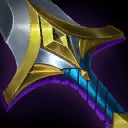 B.F. Sword and a
 Chain Vest. If the Anvil gives you
a completed offensive item, your remaining components might still form a good
frontline item. If you choose another defensive item instead, you could end up
with too much frontline and no usable damage.
The right Anvil choice often creates a balanced item portfolio rather than the single strongest item.
A practical four-bucket system
You can sort Anvil options into four buckets.
Bucket A: immediate slam, strong holder, flexible later
These are premium early choices. They improve the board now and are unlikely to become dead items later.
Examples of the profile:
- generic tank items with a real frontline holder,
- attack-speed or damage items that several carries can use,
- mana or AP items that fit multiple caster lines,
- utility items that solve a board problem immediately.
Bucket B: strong now, narrower later
These can still be correct if the immediate tempo is worth more than future flexibility. This is especially true when you are preserving a win streak or avoiding a dangerous HP loss.
Bucket C: weak now, excellent if your future comp hits
These are the trap choices when your direction is not secure. A future carry item has no value if it sits unused for several rounds while your board bleeds HP.
Bucket D: no current holder and poor future fit
These should usually be avoided unless the other options are equally awkward. An Anvil is supposed to create usable value. Do not force an item just because its standalone reputation is strong.
How much should you value early HP?
More than many players do.
If equipping an item now turns a two-unit loss into a one-unit loss, converts a loss into a win, or protects a streak, the item is creating value every round. That value compounds through:
- saved HP,
- streak gold,
- better carousel flexibility,
- less pressure to roll early, and
- more freedom to transition later.
This is why “I might need this item later” is not always a good reason to skip a slam now.
When should you choose a tank item?
A tank item is especially attractive when:
- your backline already has enough temporary damage,
- you have a strong upgraded frontliner,
- your fights are ending because the frontline disappears too fast,
- your remaining components lean offensive, or
- the tank item can transfer cleanly to several late-game units.
Frontline is often the most transferable part of an early board. That makes a good tank item one of the safest ways to convert an early Anvil into tempo.
When should you choose a carry item?
A carry item is strongest when:
- you already have an upgraded damage holder,
- the item works on multiple future carries,
- your frontline is stable enough to let the item function,
- your remaining components can cover defense, or
- your current line already points strongly toward that damage profile.
Be careful with narrow carry items if your board has no immediate user. The opportunity cost is every fight the item spends on the bench.
What if every Anvil option is awkward?
Choose the item that minimizes future damage to your game plan.
Use this tiebreak order:
- Can any option be equipped now?
- Which option has the most possible holders?
- Which option complements my remaining components?
- Which option is easiest to transfer during a transition?
- Which option solves a specific combat weakness?
If none of the items are ideal, the best choice is usually the one with the widest range of acceptable outcomes.
How Item Wisps affect Anvil decisions
Item Wisps give Set 18 players another way to repair awkward components. That means an early Anvil does not have to solve every item problem by itself.
If you know your board can use an Anvil item immediately, taking the tempo now and using a later Wisp to fix a component mismatch can be better than waiting for a perfect item structure.
Read the Item Wisps slamming guide.
Example decision 1: good tank item versus perfect future carry item
Your current board has an upgraded frontliner, a serviceable backline, and no locked endgame carry.
The Anvil offers:
- a flexible tank item that can be equipped now,
- a narrow damage item that would be excellent on one future carry, and
- a utility item with no useful current holder.
The tank item is usually the best choice. It creates immediate board strength, protects HP, and can transfer later. The future carry item has a higher ceiling only if the future board actually materializes.
Example decision 2: offensive Anvil when your bench is defensive
You already hold  Giant’s Belt, Chain Vest, and
 Negatron Cloak. Your board has enough
frontline bodies but lacks damage.
In this spot, taking another generic tank item can create an imbalanced item set. A flexible offensive Anvil choice can be better because your bench already contains the ingredients for future defense.
Example decision 3: utility when raw stats are already covered
Your carry has enough damage and your frontline survives, but enemy healing or a specific combat pattern is causing fights to slip away.
A utility option can outperform another raw-stat item because it attacks the actual reason you are losing.
Do not use a universal tier list for every Anvil
Item tier lists are useful references, but an Anvil choice is a board-state decision.
An S-tier item with no holder can be worse than an A-tier item that saves 15 HP over the next several rounds.
The correct question is not:
“Which of these items is strongest?”
It is:
“Which of these items improves my game from this exact position?”
Completed Item Anvil checklist
Before clicking an option, run this quick checklist:
- What is my board’s biggest weakness?
- Which item can I equip immediately?
- Who holds it now?
- Who can hold it later?
- What components remain on my bench?
- Does this choice leave me too heavy on offense or defense?
- Am I protecting a streak or trying to stop HP loss?
- Can a future Item Wisp repair the remaining component problem?
If one choice answers several of those questions at once, it is usually the correct Anvil pick.
Bottom line
Completed Item Anvils in TFT Set 18 reward flexible thinking. The best choice is rarely about chasing a universal BiS list. It is about converting the item into useful combat power without trapping your future transitions.
Prioritize immediate holders, transferability, board balance, and remaining components. When in doubt, choose the item that gives you the most usable outcomes instead of the item with the most impressive ceiling.